Features  Common Features
Minimum System Requirements for Win*Star 7.0
| System |
PC running Windows 8, 10, 11
Includes 32 and 64 bit versions of Windows |
| Available Hard-Drive space |
400 Mb free. |
| Other Hardware |
Printer |
| Download file size |
111 Mb |
Tables & Lists
In all Win*Star Versions

Astrologers want tools that quickly display a chart's planet and sign particulars. We've designed these analysis tools from recommendations gathered from astrologers throughout the world.
Graphs
Graphs galore are easily accessed and are designed to meet the needs of most astrologers.
Midpoint 360° Graph
 This chart reflects how the node (the ascending node) becomes the zero point or draconic equinox. The north node is sometimes called the dragon's head.
Parallels of Declination
 This gridgraph shows the relationship of the planets to the equator, geocentrically.
Grids
And Planet, Sign, Aspect, & Modality grids provide still more clarity when exploring charts.
Aspect Grid
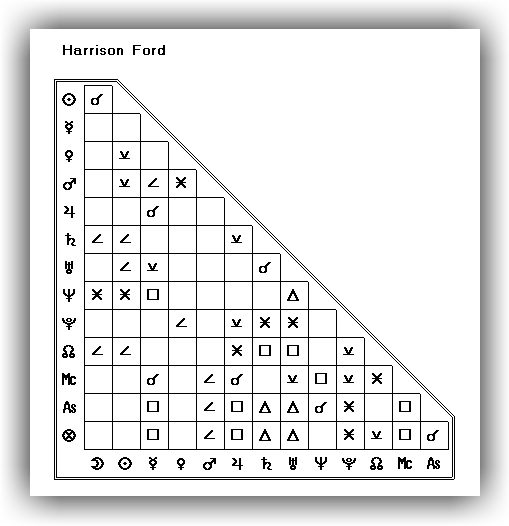 Standard and familiar aspect grid of planet rows and planet columns, showing their aspect (if any) in the block. This uses the aspect set in use when the chart was calculated.
Orbs & Angle Separation
 This shows aspects between planets/points by orb. Applying, separating, parallels, and contra-parallels are noted as well as the degree/minute distance between the planets of the highlighted chart.
[ TOP ]
Tables A few Samples
Tables, too, are always a click away and thoughtfully designed.
Chart Data 1
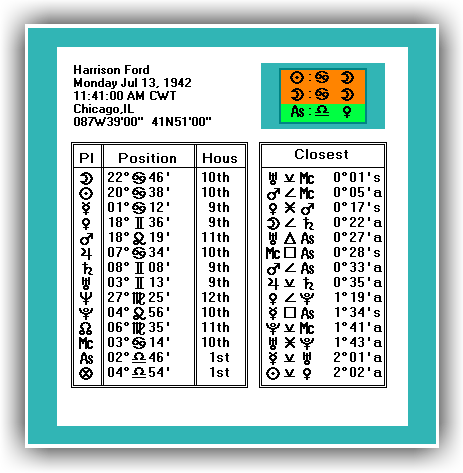 Shows basics such as: planetary longitudes, House positions, house cusps; element, polarity, and triplicity of the signs occupied by the planets; planetary hour; & approximate Sun rise & set.
Chart Data 2
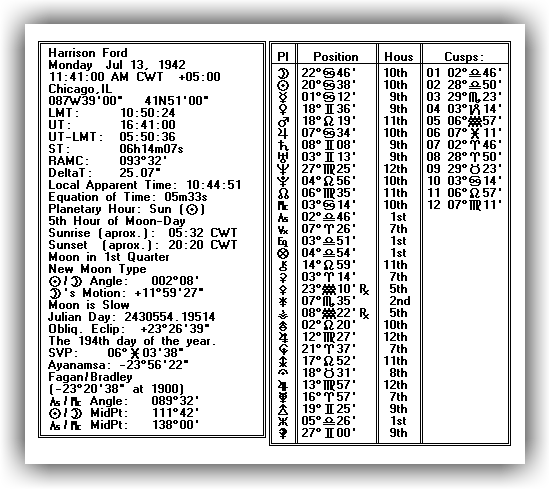 This shows planetary longitudes, house location, house cusps, technical details, minutia, technical facts about the natal chart from ayanamsa to Universal Time.
[ TOP ]
Sorts A few Samples
A list of your chart's midpoints can be very useful, particularly for showing any aspects that the transiting, progressed, or directed planets (or even another person's natal planets) might be making to these important halfway positions in your chart. But one list of midpoints is seldom sufficient. What you really need are several lists, or "sorts," because each sort organizes your midpoints in a slightly different manner.
Midpoints: 45 Dial
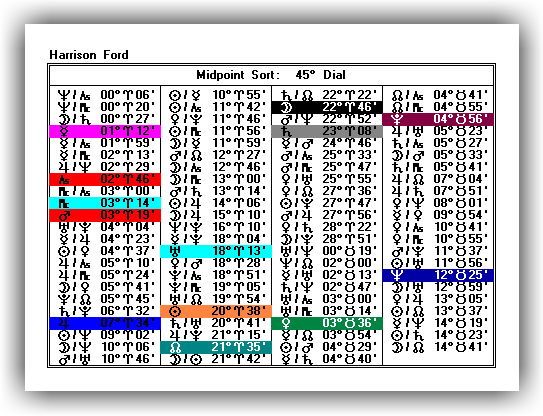 Sorts midpoints in zodiacal order, modulus 45°. Includes planet/point longitudes.
Aspects: Closest Sort
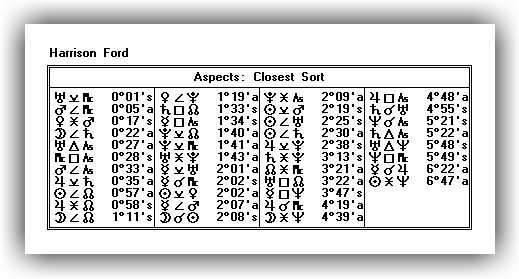 Shows major aspect patterns with the major planet in each pattern placed on the ascendant.
[ TOP ]
Chart Patterns A few Samples
Included are such patterns as the Grand Cross, T-Square, Kite, Wedge, Mystic Rectangle, Grand Trine, and many more. They are presented on screen in both geo- and heliocentric modes.
MChart Patterns
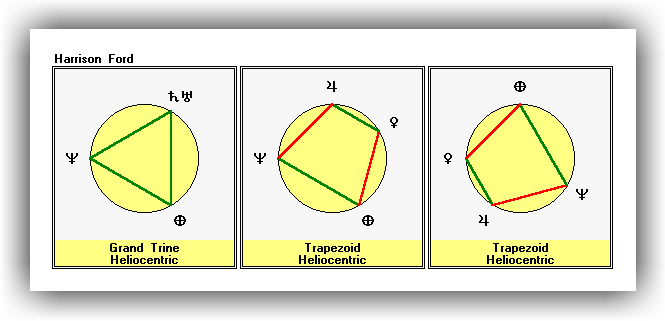 Sorts midpoints in zodiacal order, modulus 45°. Includes planet/point longitudes.
Aspects: Closest Sort
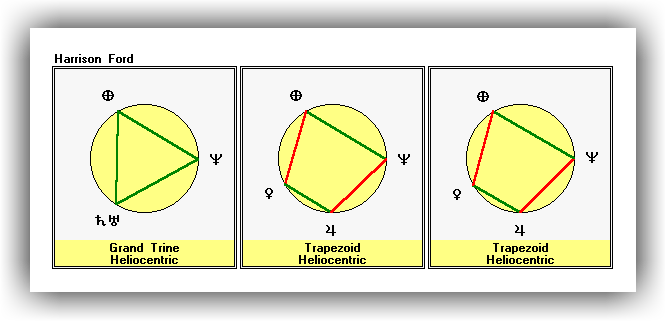 Shows major aspect patterns with the major planet in each pattern placed on the ascendant.
[ TOP ]
Next Common Feature: Techniques >
